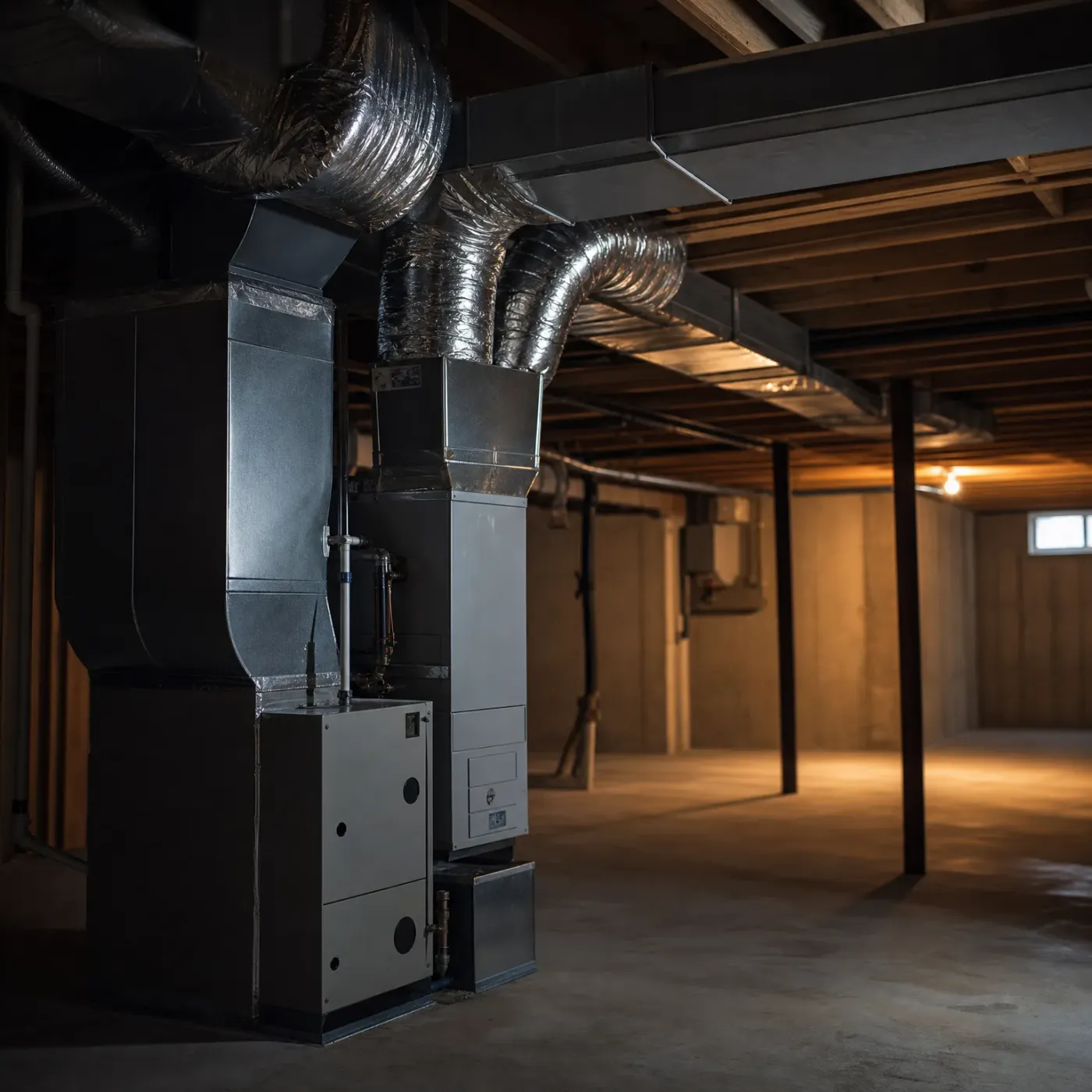

Unfinished basement with concrete floor and walls, exposed wood joists, steel support columns, and two furnace-type units connected to sheet-metal and flexible insulated ducts.

Matched to your ductwork job

Signs of mold in your air ducts in Nebraska

A musty smell when the air kicks on, dust that comes back days after you clean, or dark spots around the vent covers can all point to mold inside your ductwork. Nebraska's muggy summers give it the damp it needs. This page walks through what to look for and what it means for your ducts, so you know whether it's time to get a cleaning crew in to check it out.

Connect with a pro

A musty smell when the air kicks on usually means mold somewhere in the duct run, not just in one room. So does dust that settles back within a day or two of cleaning, or a faint dark ring around a vent cover. Mold needs moisture to grow, and Nebraska's summer humidity gets pulled into the ducts along with the cool air, then sits there if the system doesn't drain or dry the way it should. Once it takes hold on the inside of the metal or in the insulation, it spreads with every cycle of the blower, which is why the smell or the dust keeps coming back no matter how often you wipe down the vents themselves. Some people in the house may notice more coughing or stuffiness indoors than outdoors, especially in rooms fed by the same duct line. If any of this matches what you're seeing, the mold is in the ductwork, not just on a surface you can reach and clean yourself.

Unfinished basement with bare concrete walls and floor, showing exposed wood floor joists overhead with sheet-metal rectangular ductwork, insulated flexible ducts, and pipes.

What normal ductwork looks like

Metal trunk lines and flex duct running clean between the joists, with no staining on the outside and no musty smell when you stand under them. Air moves through without resistance, and the vents nearby stay dust-free for more than a day or two after cleaning.


Basement ceiling with galvanized sheet metal rectangular ducts and round pipes running between wooden joists above a bare concrete wall and floor.

What trouble looks like

Dark patches on the outside of the metal, especially near seams and low points where condensation collects. Insulation on the flex duct looks damp or discolored. If a joist near the ductwork shows dark staining too, moisture has been sitting there a while.

Can mold in air ducts actually make you sick?

Can mold in air ducts actually make you sick?

Yes, especially if anyone in the house has asthma or allergies

Mold spores are small enough to pass through a return grille and spread through the house every time the blower runs. For most people that means a stuffy nose, a cough, or eyes that itch for no clear reason, usually worse at home than away from it. For someone with asthma or a mold allergy, it can trigger real flare-ups. Babies and older adults tend to feel it first because they're breathing the same recirculated air for more hours in the day. None of this requires the mold to be visible. It can be growing on the inside of the duct walls, past the reach of a vent cover, and still be riding the airflow into every room the system serves.

Unfinished basement with galvanized sheet-metal ductwork and pipes beneath wood joists, a gray furnace unit at left, insulated plastic-covered walls over a concrete foundation, and a bare concrete floor.

Working as it should

Sheet-metal ducts running between the joists, sealed tight at every seam. No streaking on the metal, no standing water on the floor below, and the basement smells like concrete, not like a damp towel. Whatever is running through those ducts stays inside them.

Empty concrete-walled basement room with galvanized rectangular and round HVAC ducts and pipes running along the exposed wood-joist ceiling.

Signs something's wrong

The same ductwork, but look closer: rust bleeding along a seam, a seam that's pulled apart, or a joist above stained dark where water has dripped down. If the air coming off the vents smells musty before it even reaches the room, the ducts are where it's starting.

Why does your house smell different when the air is running

Walk through your house with the system on. A smell that's stronger in one bedroom than the rest of the house usually points to the duct run feeding that room. Check the supply vents for a ring of dark specks around the louvers, and look at the return grille too, since that's where air gets pulled back in and spores get pulled with it. Pull the furnace filter and look at the side facing the blower. If it's streaked gray or black instead of evenly dusty, air is carrying more than dust through your ducts. Left alone, that air keeps moving through every room on the system, and anyone in the house with allergies or asthma will likely notice it before anyone else does.

Empty basement room with bare concrete walls and floor, with exposed wooden joists, sheet-metal HVAC ducts, an insulated flexible duct, and pipes running across the ceiling.
Before you get your ductwork cleaning
Empty unfinished basement with bare concrete walls and floor, showing galvanized sheet metal ductwork, insulated flexible duct, and pipes running along the wood-framed ceiling, with a small window at left.
After you get your ductwork cleaning

A duct system pro near you

You can smell the mold before you can see it, and by the time a dark ring shows up around a vent cover, it has had a while to spread through the duct run. Checking every supply vent in the house, sorting out which room smells worse, and figuring out if what you're looking at is actually mold or just dust takes time most people don't have. A contractor who does this for a living can look at the same ring, the same smell, and tell you in minutes what it would take you an afternoon of searching and guessing to work out. Nebraska's humid summers mean this isn't a one-time problem either; the same conditions that grew it once can grow it again if the moisture source never got addressed. Getting matched with someone who handles this regularly means you're not starting from scratch, calling around and explaining the musty smell and the dust and the vent stains to five different people before you find one who can actually look at your system.

A smiling gray-haired man in a dark wool coat with snow flecks stands in a dimly lit home entryway, with a lit table lamp, potted plant, framed pictures and a living room visible behind him.
An older man with gray hair and a beard, wearing a snow-dusted dark coat and knit scarf, stands smiling in a dimly lit house entry with a lit lamp, mirror, and a living room with snow visible through the window behind him.
An older man with gray hair and a beard, wearing a dark snow-dusted coat and plaid scarf, stands smiling in a warmly lit hallway with a lamp, side table and glass-paned doors behind him.
An older man with gray hair and a beard, wearing a dark coat dusted with snow, stands in a home entryway with a lit lamp, a staircase railing, and a living room with large windows behind him.

Power costs 12.05 cents per kilowatt-hour statewide

Electricity runs 12.05 cents a kilowatt-hour across Nebraska, cheap enough that most people don't think twice about running the blower harder or longer. If mold is sitting in the ducts, that cheap power just pushes spore-laden air through the house instead of fixing anything.

EIA-861 2025 statewide residential average

A duct system moves the same air through your house again and again, so whatever is sitting in the ducts gets a pass through every room, not just the one near the leak or the damp spot.

That's why mold in one duct run can show up as a smell in a bedroom down the hall, and why cleaning it out addresses the whole house, not just where you first noticed it.

A woman with dark shoulder-length hair sits wrapped in a gray fleece blanket on a sofa with an open book on her lap, beside a lit lamp and a dark window.
A woman in a cream knit sweater sits in an armchair indoors, eyes closed and smiling, beside a window showing yellow and orange autumn foliage, with a mug on a wooden side table and shelves holding vases behind her.
A woman in a long cream cardigan and jeans stands at an open wooden front door of a gray shingled house with stone-based porch columns, with a second person visible inside, and potted flowers and shrubs beside the entry.

Where that leaves you

A musty smell, dust that comes back fast, a dark ring on a vent cover. Any one of those is worth paying attention to, and Nebraska's summers give mold the damp it needs to settle into a duct run and stay there. You don't need to see the mold to know something's off. The smell and the dust are enough to act on.

What you don't have to do is figure out which contractor to call, explain the smell and the dust and the vent covers to three different companies, then sit with their quotes trying to compare apples to apples. Once you answer a few questions about your situation, a contractor who handles this in your area gets in touch with you directly.

A speckled beige ceramic vase holding thin dried branches sits on a round wooden table near a window with sheer curtains, with a dark upholstered chair and draped blanket blurred in the background.
A shingled two-story house with lit windows and stone accents at dusk, with a stone paver walkway and landscape lighting leading past ornamental grasses toward a calm bay under an orange and blue sky.

Ductwork Cleaning

A local pro for your ductwork cleaning

Duct and vent cleaningDucts or ventsNebraska
Step 1 of 2

What ZIP code is the job in?

  • A beige upholstered armchair with a cushion and knit throw sits beside a double-hung window with a woven shade, next to a white fireplace mantel with a lit fire, a vase of greenery, and a round wooden table in the foreground.
    • Say what's going on with your ductwork, and a pro who works on them reaches out.
    • A local pro who knows ducts gets your details and gets in touch.
  • A shallow speckled beige ceramic bowl holding a leafy green branch sits on a wooden dresser beside a tall matte stoneware vase, with a window at left and a dark-framed picture at right.
    • Once you send the form, finding a pro is off your list.
    • After you send the request, you're done searching.
  • A ceramic table lamp with a pale tapered fabric shade sits on a rustic wooden table beside a wooden bowl, with a framed artwork on the beige wall and sunlight from a window at left.
    • Describe your ductwork job once, to one pro.
    • Fill out one short form instead of calling around.
  • A black box-shaped outdoor wall lantern with seeded glass panels and a lit filament bulb mounted on a light gray board-and-batten exterior wall, beside a dark-framed glass door, with green leafy shrubs in the foreground.
    • Your duct cleaning request goes to one local pro.
    • Your request goes to one pro, not a list of companies.