







A layered sandstone outcrop atop a grassy hill lit by low golden light, with rolling prairie hills and a clear gradient sky in the background.Hand it off

Musty smell from vents in Omaha, NE

One request and the duct cleaning stops waiting on you.

You turn on the furnace or the AC and that musty smell comes right through the vents. In a house with Omaha's humidity to deal with all summer, that usually means moisture sitting somewhere in the duct system, and it does not air itself out on its own.

A smell like that does not come from nowhere. Dust and moisture build up inside ductwork over time, and once mold or mildew gets a foothold in there, running the system just pushes that air through every room it feeds. Cleaning the ducts is the way to deal with it at the source, not just mask it.

What you do not want to spend your evening on is calling around Douglas County trying to find someone who does this work, explaining the smell over the phone three or four times, then sitting on quotes trying to figure out who actually knows what they are doing. That is the part this page takes off your plate.

Send the form and the search for a contractor stops being something you have to manage. No more lining up calls after work or chasing down someone who never called back. Someone who handles duct cleaning in the Omaha area gets your information and takes it from there.

You still live with the smell until it is handled. But you are not the one hunting down who can handle it. That part is done once you hit send.

That musty smell is almost always mold or mildew growing somewhere in the duct system, not just dust burning off. Ductwork holds onto moisture whenever condensation forms inside it, which happens easily once the AC has been running for weeks of sticky Omaha summer, or if a duct runs through a damp crawlspace or basement. That dampness sits in a dark enclosed space with no airflow to dry it out between cycles, which is exactly what mold needs to take hold. Once it's growing on the duct walls or the coil, every time the system kicks on it pushes that smell into every room the ducts feed. A dirty filter can add a stale smell too, but if it's distinctly musty rather than just dusty, something in the system is holding moisture. It will not clear up by running the fan more or swapping the filter. The ducts need to be inspected and cleaned, and whatever is letting moisture collect needs to get fixed too.

Empty unfinished basement with concrete walls and floor, exposed wood joists, metal HVAC ducts and pipes overhead, and a steel support column near a framed wall.
Ducts like this move air without holding onto any smell, because nothing inside them stays wet long enough to grow anything.
Empty basement with bare concrete walls and floor, a steel support column, and galvanized sheet-metal ductwork and pipes running along the exposed wood joist ceiling.
Ducts like this have a damp patch or hidden buildup somewhere in the run, and that is what you are smelling every time the air kicks on.

Mold does not grow just anywhere in a duct. It needs water sitting still, dust to feed on, and no airflow to dry things out, and a duct system gets all three if nothing is done about it. That is why the smell often hits hardest in a guest room or a room you keep closed off. The air barely moves through that vent, so whatever is growing near it never gets disturbed. Follow the ducts back and you will usually find water where it should not be. The evaporator coil behind the furnace sheds condensation the whole time the AC runs, and if it is dirty, that water has somewhere to cling. Ducts that pass through a crawlspace or basement pick up moisture through the seams from the ground and the air around them. A clogged condensate line will back water up into the system itself instead of draining it outside, and standing water like that turns musty in a matter of days. Cleaning out the ducts clears what is already growing, but it does not stop the coil or the drain line from sending more moisture back in.

Where the smell actually starts

  • Mold needs standing moisture, a food source like dust, and still air, and a duct system left alone all summer gives it all three.
  • The smell is usually strongest right at the vents in rooms you use least, since the air there moves the slowest.
  • A dirty evaporator coil behind the furnace is a common source, because condensation drips off it constantly while the AC runs.
  • If the ductwork runs through a crawlspace or basement, groundwater and humidity can seep into the metal seams and feed growth from outside the duct.
  • A clogged condensate drain line backs water up into the system instead of carrying it outside, and that standing water turns musty within days.
  • Cleaning the ducts removes the buildup mold is feeding on, but it will not fix a coil or drain line that keeps adding moisture back in.
A man in a gray knit sweater stands smiling and looking off to the side beside a white marble kitchen island, with a dining table, pendant light, and open shelving in the background.
A smiling man with short dark hair and stubble in a gray sweater sits at a stone-topped counter with a white ceramic mug, in a room with a framed picture, a plant, and shelves holding bowls.
A smiling man in a dark navy sweater sits at a wooden kitchen counter with a light ceramic mug, with white tile backsplash, open shelving and a window with potted plants behind him.
A smiling man with dark hair and a beard, wearing a dark green knit sweater, stands at a kitchen counter with a ceramic mug, with an open living room, sofa, armchair and large windows behind him.

It's off your list after this

You could spend an afternoon calling around to find out who actually cleans ducts in Omaha, waiting on callbacks, explaining the smell three or four times over, then lining up quotes to see who's reasonable. That smell does not wait for all that. Once mold has a foothold in the ductwork, it keeps circulating through every room on the system, not just the one that smells worst. Send the request once and the search ends there. It goes to one contractor who works in Douglas County, not a batch of five fighting for your callback, and there is nothing owed by filling it out. What is left is the part that was always going to take a visit anyway, someone looking at the actual ducts and finding where the moisture sits. Getting that scheduled is the only step left, and it stops being something you have to chase down yourself.

A duct cleaning doesn't just pull out dust. It has to get the moisture source dry and remove whatever the mold has been feeding on, or the smell comes back within weeks.

That's why a shop vac on the supply registers never fixes this. The buildup is usually further back in the run, past where you can reach it yourself.

Why does this smell keep coming back in your house?

  • Half the homes here were built by 1977

    Half the homes in Douglas County were built in 1977 or earlier, so a lot of duct systems here are original and have had decades to collect moisture and dust.

  • Heat runs October through May

    Heat runs October through May here, about eight months. That's eight months of warm air pushing through ducts that may already hold a damp patch.

  • Cooling runs June through September

    Cooling runs June through September. Four straight months of condensation forming in the ductwork gives mold the steady moisture it needs to take hold.

ACS 2020-2024 · NOAA nClimDiv 1991-2020

A dim room corner with a dark grey sofa and cushion, a wooden side table holding a ceramic vase and a small potted plant, a linen curtain beside a bright window, and a wall vent near the ceiling.

It's a Saturday afternoon in April and you've finally got the windows open for the first time in months. The ceiling vent in the living room catches the light and you notice it, a soft gray ring of dust on the grille, and a thin film of it settled on the bookshelf underneath. You run a finger along the shelf and it comes away dark. The furnace kicked on earlier for the last cold morning of the season, and whatever blew out of that vent is sitting on everything in the room now. You hadn't thought about that grille since fall.

Why does the smell hit hardest in certain rooms?

Walk past a vent in the spare bedroom or the basement and the smell gets stronger, then it fades near the vents you use every day. You might notice it most when the AC first kicks on, a damp, closed-up smell that clears some after a few minutes of airflow, then returns the next time the system cycles. Some households notice it more in a specific room, or more on humid days than dry ones. Left alone, the mold feeding on that dust keeps spreading through the duct run, and anyone in the house with allergies or asthma is breathing it every time the air kicks on.

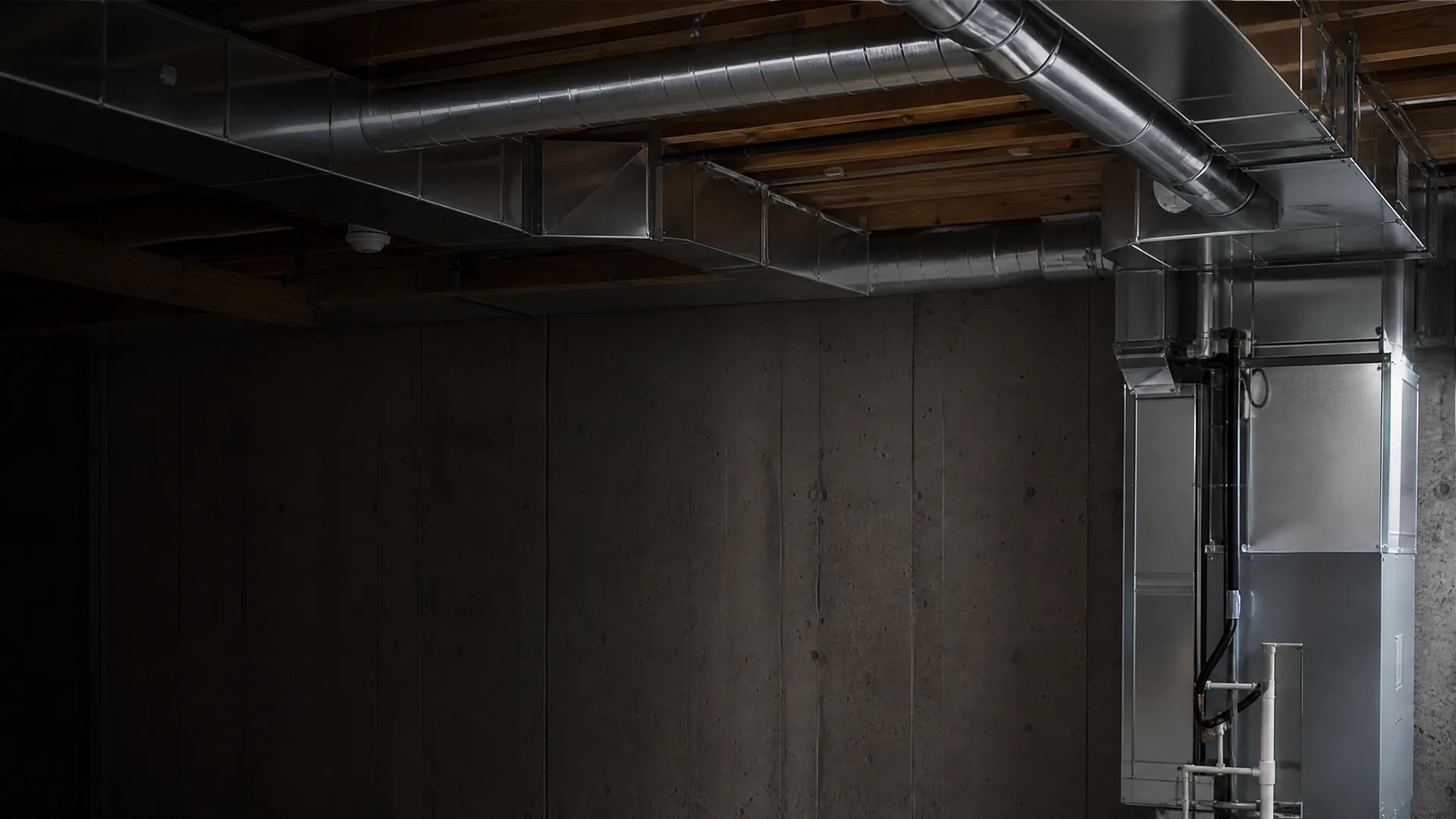
Unfinished basement with concrete floor and walls, exposed wood joists, steel support posts, and large galvanized sheet-metal ductwork running to a furnace or air handler against the far wall.

Ducts doing their job

This is what a duct run should look like. Air moves through the metal trunks and back to the furnace, and nothing lingers long enough to turn into a problem. A system like this doesn't feed a smell because there's no standing moisture for mold to use.


Galvanized sheet-metal ductwork and round pipes run along a wooden floor joist ceiling above a bare concrete wall and floor.

Ducts holding a smell

Same kind of runs, but somewhere along this one, moisture is sitting still and mold has a foothold. You won't see it from here. You'll smell it instead, every time the furnace or the AC pushes air past that spot.

A bearded man in a navy t-shirt sits on a beige sofa, laughing while looking toward a laptop screen visible in the lower foreground, with a houseplant, shelves, and a framed picture behind him.
A bearded man in a plaid flannel shirt stands indoors looking out a condensation-covered window at a snowy landscape, with a speckled mug on the sill and kitchen shelves behind him.
  1. A technician opens the trunk line and checks for standing moisture first.

  2. A high-powered vacuum pulls negative pressure through the whole duct system.

  3. A rotating brush knocks loose dust and mold stuck to the duct walls.

  4. Every supply and return vent gets cleaned before the system runs again.

Power here costs 13.13 cents per kilowatt-hour

Cheap power at 13.13 cents a kilowatt-hour means running the blower longer or adding a UV light inside the ductwork won't hit your bill hard. The real cost of a musty duct system isn't the electricity, it's the mold that keeps growing until someone actually cleans it out.

EIA-861 2025

Where That Smell Leaves You

  • A musty smell from your vents means moisture and mold somewhere in the duct system, not just dust burning off.
  • The smell comes back within weeks if the moisture source and what the mold is feeding on never get removed.
  • Ductwork built in 1977 or earlier has had decades to collect the dust and moisture that feed this problem.
  • A shop vac on the registers only reaches what's in front of it and leaves the actual buildup inside the trunk lines.
  • A technician checks for standing moisture, pulls negative pressure through the whole system, and brushes the duct walls clean.
  • Finding out who cleans ducts in Omaha, waiting on callbacks, and comparing quotes is the part you don't have to do yourself.

The smell from your vents is mold or mildew sitting somewhere in the duct system, feeding on dust, waiting for someone to deal with the moisture that's keeping it alive. It will not go away by running the fan more or waiting for drier weather. Every summer the AC runs, more condensation forms inside that ductwork, and the smell gets another reason to stay. If your house is one of the many in Douglas County built in 1977 or earlier, that duct system has had a long time to build up what's feeding the problem now. None of that gets fixed by vacuuming the registers you can reach. The buildup lives further in, in the trunk lines, and it takes someone opening that system up, checking for standing moisture, pulling air through the whole run, and brushing the duct walls to actually clear it out. Skip any of that and the smell is back in a matter of weeks. What you're left with otherwise is the part that eats your afternoon: calling around to find out who even does this kind of work in Omaha, waiting for someone to call you back, describing the same musty smell to three different people, then sitting with quotes trying to figure out who actually knows what they're doing. That's the part that goes away once you send the request. The smell in your house does not wait for any of it, and you shouldn't have to either.

Unfinished basement with poured concrete walls, exposed wooden joists, and galvanized sheet-metal supply ducts and round pipes running along the ceiling to a furnace unit at right.

Stop chasing a duct system pro

Explain the job once and skip repeating it on every call.

Duct and vent cleaningDucts or ventsDouglas County, NE
Step 1 of 2

What ZIP code is the job in?