

Signs of leaky ductwork in Grand Island, NE

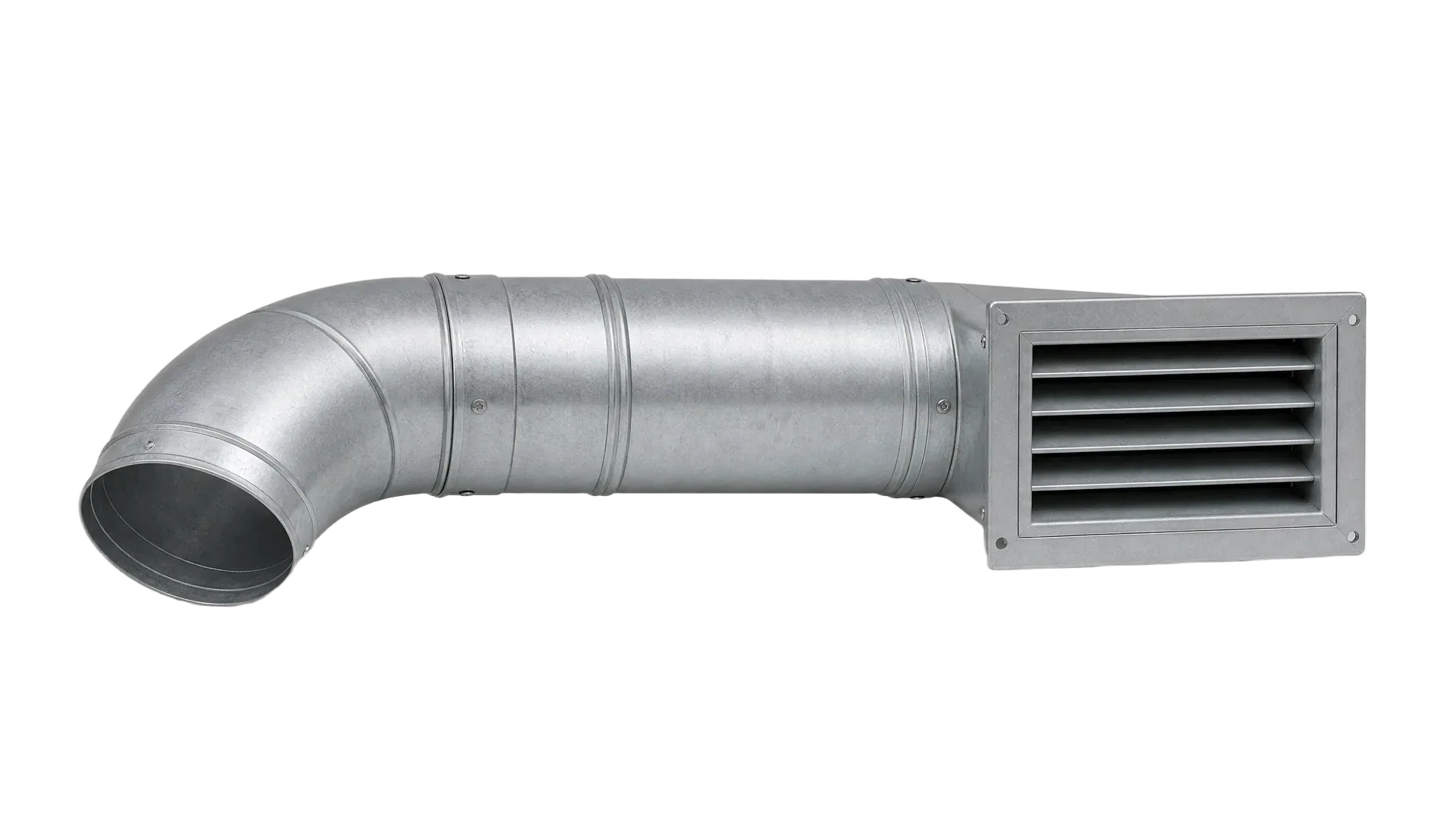
A galvanized metal round duct with a 90-degree elbow connected to a rectangular louvered vent grille, shown against a plain gray background.
Send my request

How do I know if my ductwork is leaking?

You catch yourself wondering about this because a room or two never feels right, or the furnace seems to run longer than it should. You haven't seen the ducts themselves, they're up in the attic or under the house, so you're left reading the signs the house gives you instead.

Uneven rooms, dusty air, and higher bills than the house should run

A duct that's leaking shows up as a room that won't hold temperature the way the rest of the house does, usually the one farthest from the furnace. You may also notice more dust settling around vents, or a bill that climbs even though you haven't changed the thermostat. This happens because the air your furnace heats or cools is escaping into the attic or crawlspace before it ever reaches the register. Winters here are hard and summers get sticky, so a duct losing air means the system has to run longer to make up for what never arrived, and that shows up on the gas and power bill both. If your ducts came with the house, gaps at the joints are worth checking first.

Unfinished basement with concrete floor and walls, exposed wood joists, galvanized sheet-metal ductwork, a furnace unit, a steel support column, and a small window.
Sealed joints and solid metal runs mean the air leaving your furnace is the air that reaches the vent.
Empty unfinished basement with bare concrete walls and floor, showing exposed wooden joists, galvanized sheet-metal ductwork, pipes, and a white vent grille overhead.
A loose flex connection and bare joists like this let heated or cooled air spill into the basement instead of your rooms.

Why does duct leakage matter so much here?

  • Half the homes here were built by 1975

    Half the homes in Hall County were built in 1975 or earlier. Older duct joints dry out and separate over time, so a system that age is worth checking.

  • Heat runs October through May

    Heat runs about eight months a year here, October through May. Leaky ducts waste gas every one of those months, not just a few.

  • Cooling runs June through September

    Cooling runs June through September. Leaks that lose conditioned air show up fast in a Grand Island summer, when the house struggles to keep up.

ACS 2020-2024 · NOAA nClimDiv 1991-2020

What a hand check tells you

Shut off the furnace and walk the house with your hand near each supply vent. A steady trickle of air where you expect none, or a vent that stays cool when the rest of the house warms up, points to a leak somewhere between that vent and the furnace. Check the return side too. If the air near a return duct joint feels different from the room around it, that joint is pulling in attic or crawlspace air instead of room air, and the furnace is working on air it never should have gotten.


What the furnace itself shows

A furnace pushes a fixed amount of air through the ducts every time it runs. If a good share of that air leaks out before it reaches a vent, the furnace has to run longer to bring the house up to temperature, since the thermostat only sees what actually lands in the room. Watch the run time on a cold morning. A cycle that stretches past what it used to, with no other change in the house, is the furnace telling you some of its air isn't getting where it's supposed to.

A smiling man in a dark green sweater sits at a wooden table with a light gray mug in a kitchen with white tile backsplash, pendant lights, and an adjoining living room visible.
A smiling man in a dark gray sweater stands indoors looking to the side, with a kitchen counter holding a ceramic mug and open wooden shelves behind him and a living area in the background.
A smiling man in a dark blue button-up shirt stands at a white kitchen island, with open shelving, a gas range, a potted plant and a window in the background.
A smiling man with dark wavy hair and a beard, wearing a dark green knit sweater, sits in an open-plan living room and kitchen with a brown sofa, large windows, and a counter holding a mug and a wooden bowl.

Why duct location changes the leak

  • Supply ducts run under positive pressure, so a gap in the metal pushes conditioned air out instead of into the room.
  • Return ducts run under negative pressure, so a gap there pulls in attic or crawlspace air instead of room air.
  • A leak on the return side can draw in dust, insulation fibers, or crawlspace odors and feed them straight into the furnace.
  • Leaks near the furnace or air handler cost more air per square foot of gap than leaks out at the far end of a run.
  • Flex duct connections, the crimped collar where flex meets a metal boot or trunk line, work loose before the straight metal seams do.
  • Mastic sealant holds up over the years; cloth-backed tape on old ductwork dries out and lets go at the seams.

Air moves through your ducts under pressure, and which side of the furnace a leak sits on decides what happens at that gap. The supply side pushes air out toward your rooms, so any opening there is conditioned air leaving the system before it reaches a vent. The return side pulls air back toward the furnace, so a gap there does the opposite: it draws in whatever is nearby, attic air, crawlspace air, dust, insulation fibers, and pulls it into the air stream headed for your furnace. That's one reason a musty smell from the vents often traces back to a return leak rather than a supply one. Where the leak sits along the run matters too. A gap close to the furnace or air handler is moving more air through that opening than a gap of the same size out near the end of a branch line, so the losses near the equipment add up faster. The weak points tend to be the same from house to house. Flex duct meets metal at a crimped collar, either a boot where the duct drops into a room or a connection to the trunk line, and that collar works loose years before a straight metal seam would fail. Older ductwork sealed with cloth-backed tape is also worth a look, since that tape dries out and lets go at the seams over time, where mastic sealant holds its grip for years.

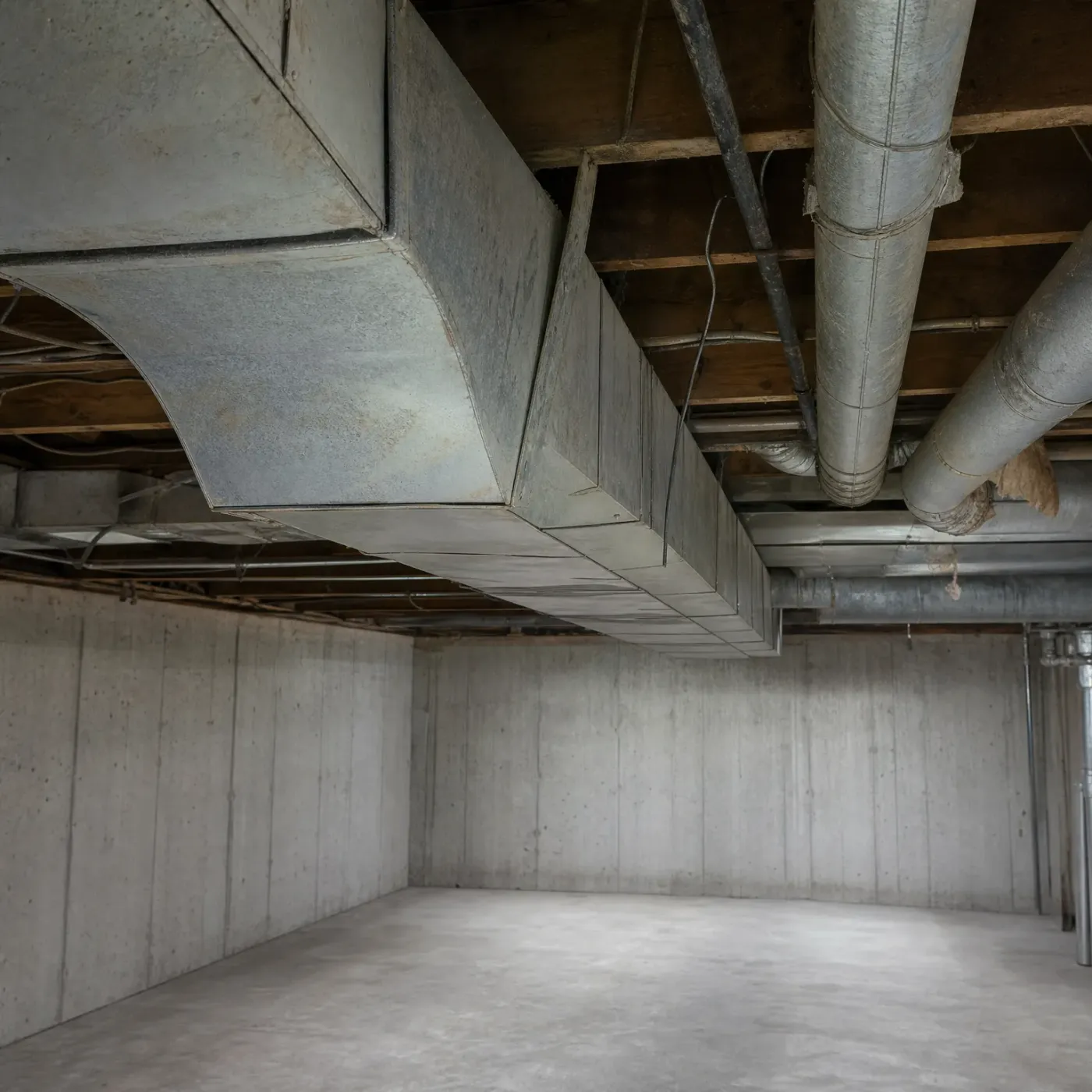
Empty concrete-walled basement with bare floor, showing large galvanized sheet-metal HVAC ducts, insulated pipes, wiring and wooden floor joists overhead.
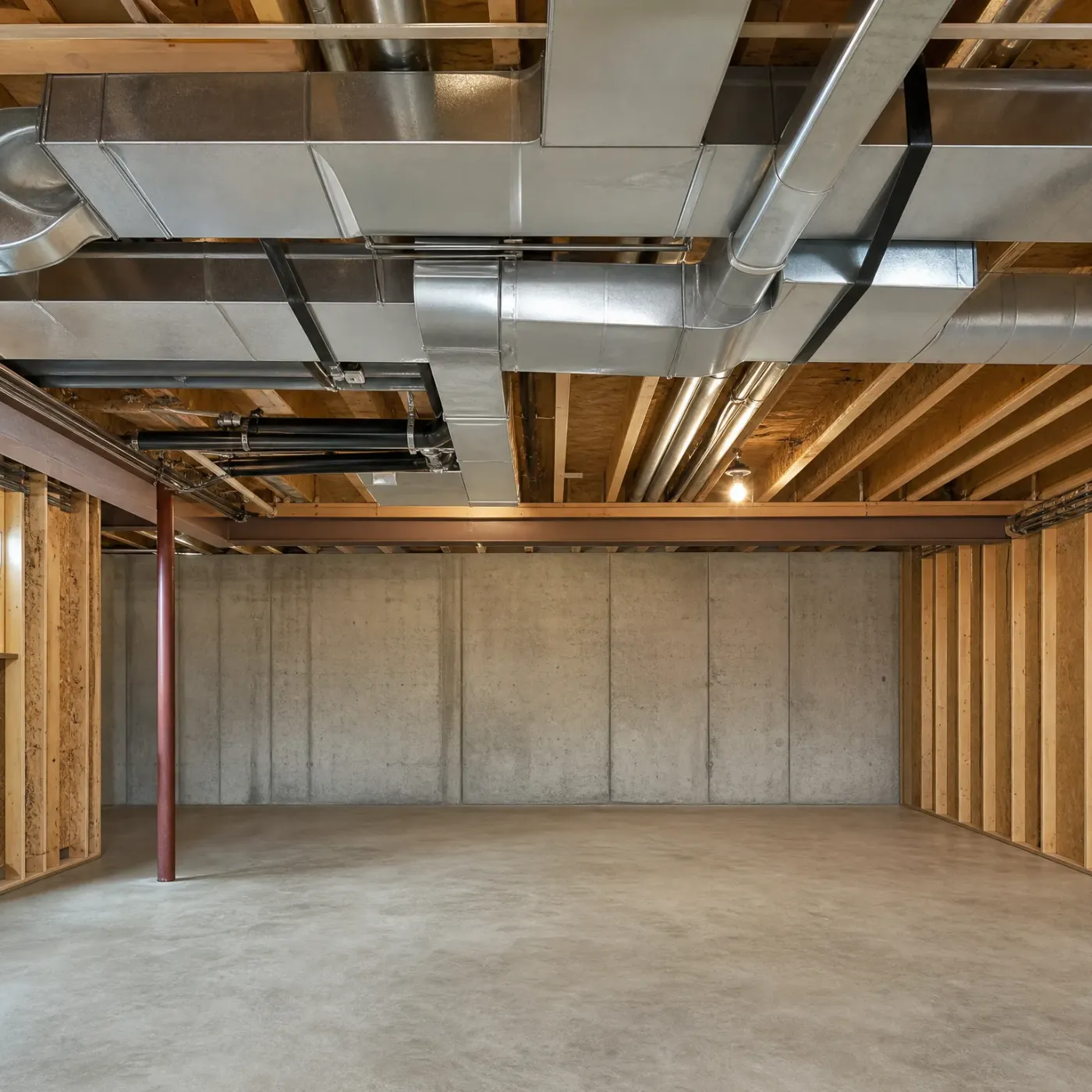
Before you get your ductwork cleaning
Empty unfinished basement with bare concrete floor and wall, wood-framed stud walls, exposed joists, galvanized HVAC ducts and pipes overhead, a steel beam and red support column, and a single bare bulb light.
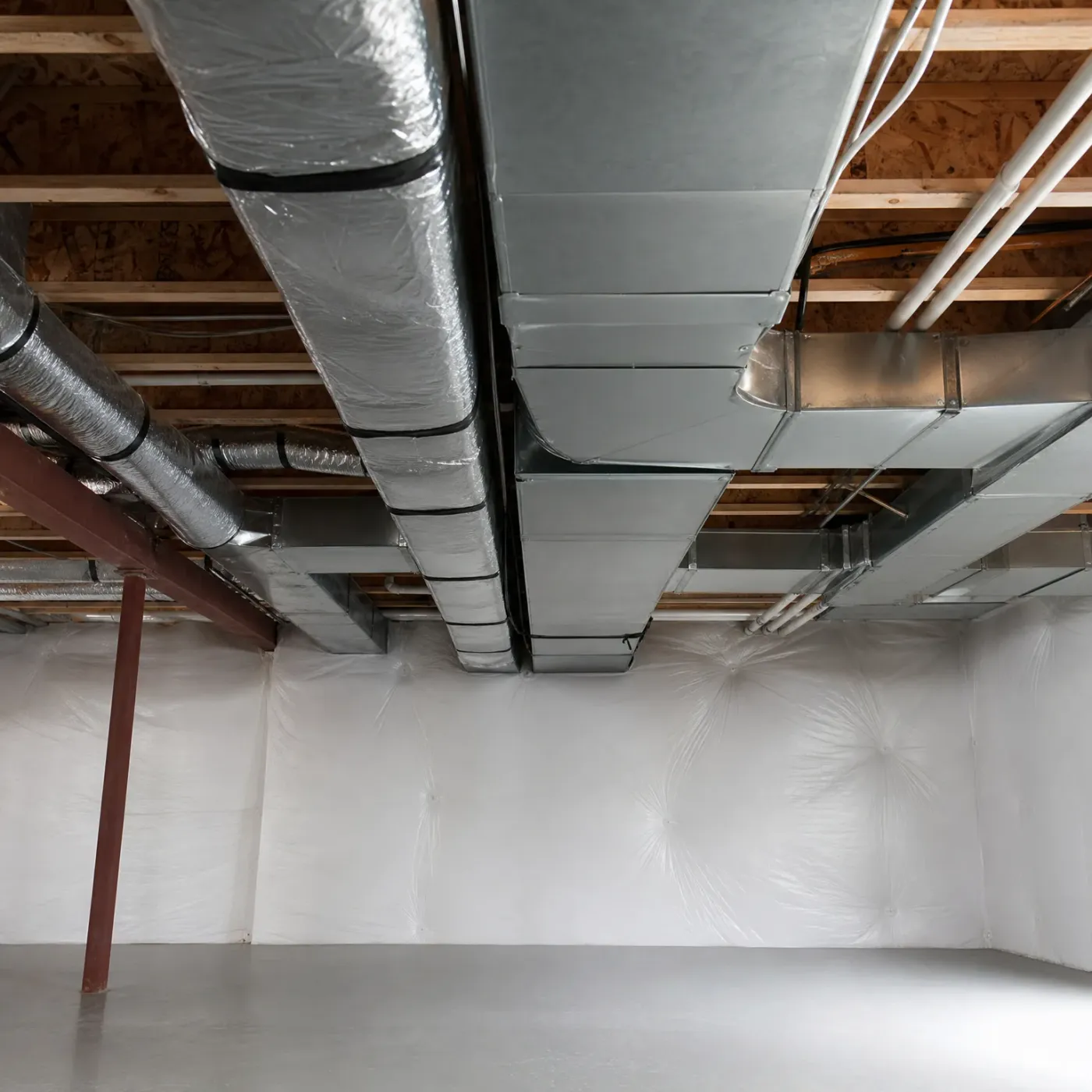
After you get your ductwork cleaning
Unfinished basement with exposed wood joists, sheet metal and insulated flexible ductwork, white pipes, a steel support post, plastic-covered walls, and a bare concrete floor.

Ductwork done right

Sealed metal trunks and wrapped flex runs sit tight against the joists, each joint banded or mastic sealed. Air that leaves your furnace stays inside the duct the whole way to the vent. Nothing spills into the basement along the way.

Galvanized sheet-metal ductwork and round pipes run beneath wooden floor joists in a basement with concrete walls and floor.

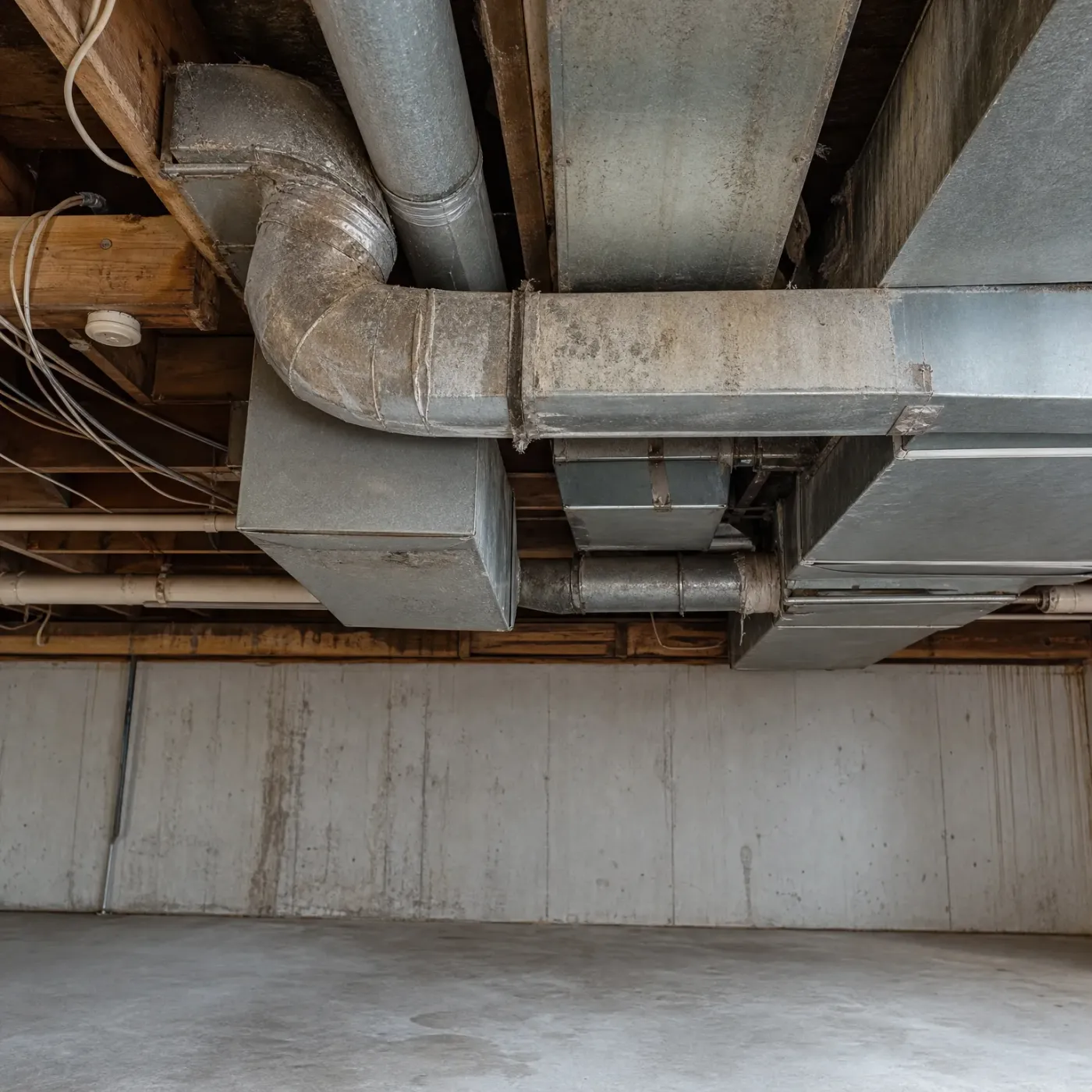
Ductwork in trouble

A bare flex elbow connects loosely to the trunk line here, with no wrap or seal holding it to the metal. Joints like this work loose as the house settles, and a gap this size lets a steady stream of heated or cooled air escape before it reaches a single room.

A bearded man in a dark t-shirt sits on a light sofa, smiling and looking down toward a laptop screen visible at the bottom edge of the frame, with a blurred living space behind him.
A bearded man in a plaid flannel shirt looks out a window at snow-covered conifer trees, with a steaming ceramic mug on the sill and wooden shelves holding dishes and a plant behind him.

Finding a pro stops being your job

You've read the signs above and maybe found a few in your own house. Knowing where the leak probably is doesn't get it sealed. That takes someone crawling through your attic or basement with mastic and sheet metal tape, checking every joint by hand, and most people don't have a contractor they already trust for that kind of work. Without this, you'd be searching listings, calling around to see who even does duct sealing in Hall County, explaining the same hand-check results three or four times, then comparing quotes that are hard to judge against each other since you don't know the trade. Send the form instead and that work is off your plate. With a furnace that runs eight months a year here, every month the leak sits unfixed is a month of heated air going into the attic instead of your living room. Handing this off now means the search ends today instead of after a weekend of phone calls.

A dimly lit living room corner with a gray wall, framed picture, a table lamp on a wooden side table, a beige sofa with pillows, a ceiling vent, and windows showing flowering trees outside.

It's a warm April afternoon and the sun through the front window is showing you something you hadn't noticed all winter. A gray ring of dust sits on the ceiling vent grille in the living room, and the same fine dust has settled on the lamp shade and the top of the bookshelf below it. You run a finger along the shelf and it comes back dark. The vent itself looks almost furred at the edges. You hadn't thought about it before now, with the furnace quiet and the windows cracked, but the pattern on the furniture tells you air has been moving through that grille all winter, carrying more than heat with it.

A wooden table in the foreground holds a closed laptop and a ceramic mug of coffee, with a spindle-back wooden chair behind it, a beige wall with paneled wainscoting, a window at left, and a kitchen counter with a cutting board, bowl of fruit and greenery at right.

What a leak costs you month to month

Power is cheap in Hall County, but a duct leak still shows up on the bill, because the furnace has to run longer to make up for what never reaches the vent. You'll notice it more in January than in April, since the furnace is working harder to begin with. A room that stays cold no matter what you set the thermostat to usually means the duct feeding it is losing air somewhere between the furnace and the grille.

There's also what you can't see. A return leak in the basement or crawlspace pulls in dust, and some of that ends up in the air you breathe before the filter ever gets a chance at it. Once you've found a sign or two, the next step is getting someone to open up the duct and look. That usually means calling around, explaining what you noticed more than once, and sorting through quotes from people you've never worked with. Sending the form here skips that part. You describe it once, and finding someone to check it becomes someone else's job instead of yours.

A shallow dark wooden bowl and a stack of books rest on a wooden table in front of a beige sofa with linen and green cushions, with a tall ceramic vase of thin branches beside a window in the background.

Power here costs 10.34 cents per kilowatt-hour

At 10.34 cents a kilowatt-hour, your electric bill isn't the main cost of a leaky duct. Most of that loss shows up on the gas side, from a furnace running longer to cover what the leak lets escape. The blower motor still runs on that cheap power, so it earns you back less than you'd think.

EIA-861 2025

  1. Air leaves the furnace through the trunk line under positive pressure.

  2. A gap or loose joint lets heated or cooled air escape before it reaches a vent.

  3. Air pressure inside the house drops, pulling outside air in through small cracks.

  4. The furnace runs longer to replace what the leak let escape.

A leak doesn't announce itself. It shows up as a room that never quite warms up, a furnace that runs long, dust on a vent grille you hadn't noticed before. Taken together, those are the signs, and in a county where half the houses are old enough to have duct joints that have dried and pulled apart, they're worth paying attention to. You don't need to find the exact gap yourself or climb into the attic to confirm it. What you need is someone who checks every joint by hand and seals what's actually leaking, not a guess. Getting there usually means calling around, explaining the same problem to a few different companies, and sorting through quotes that are hard to compare. Send the form instead, and that part is no longer yours to do. You already know what you're hearing in that room. The next step is getting someone there who can trace it to the joint.

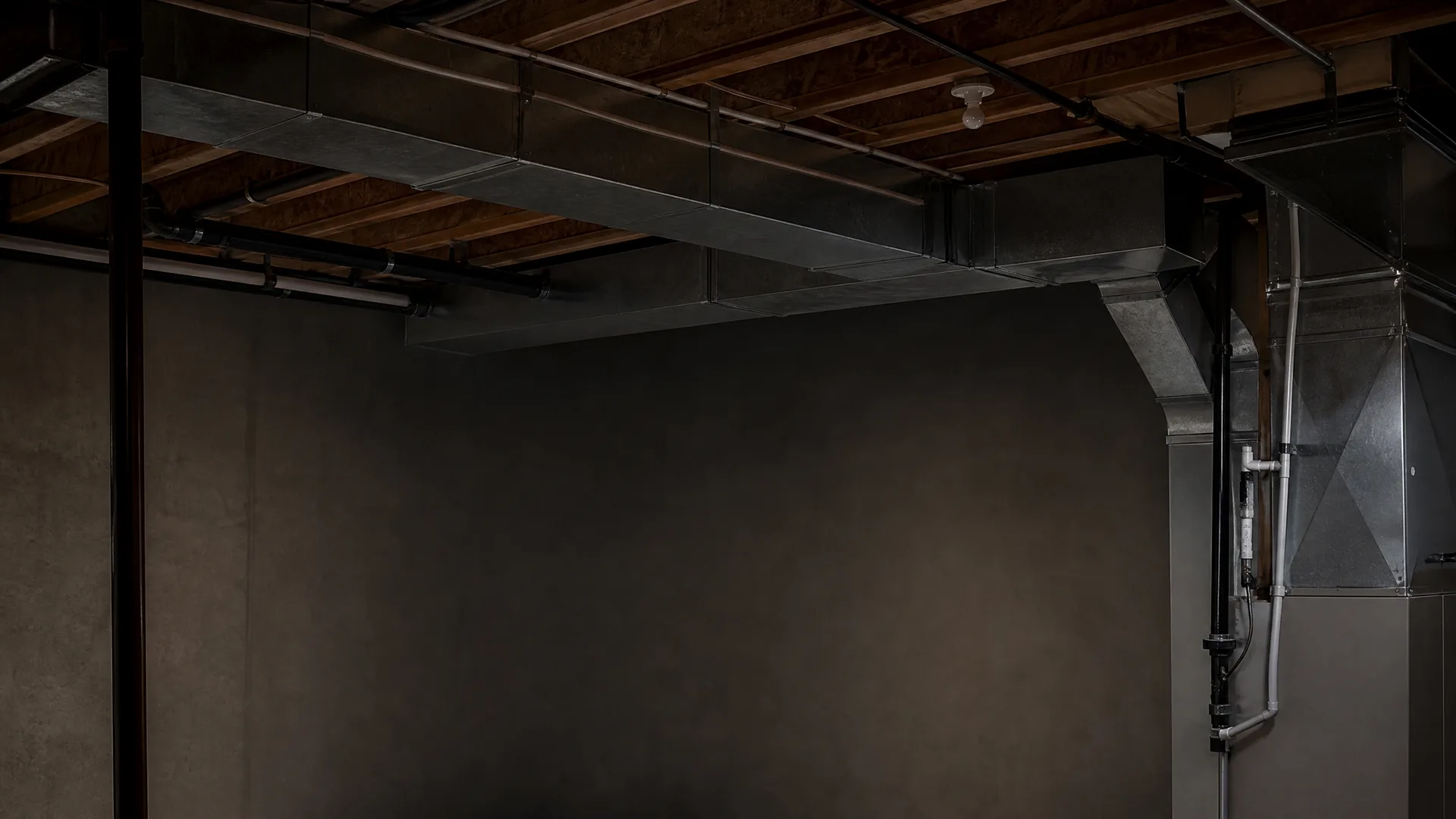
Dim interior with a dark gray wall, exposed wood joist ceiling, sheet-metal ductwork, conduit, pipes and a sprinkler head.

Let someone else find the pro

One form replaces the calls you'd make to find a duct system pro.

Duct and vent cleaningDucts or ventsHall County, NE
Step 1 of 2

What ZIP code is the job in?