







Signs of a clogged dryer vent in Kearney, NE

Get matched with a pro who works on dryer vents in Buffalo County.

Get a local pro

What are the signs of a clogged dryer vent?

Your dryer has been running longer than it used to, or the clothes come out hot but not fully dry. Maybe you noticed the top of the machine feels warmer than usual, or you caught a faint burning smell the last few loads. Buffalo County winters put dryers to harder use for months at a time, and a vent that's been building lint for a while starts showing itself in small ways before it becomes a real problem.

Clothes take more than one cycle to dry, and the dryer runs hot

A clogged vent can't carry the hot, damp air out of the dryer fast enough, so the drum stays full of moisture and the cycle has to run again to finish the job. You'll also notice the dryer itself gets hotter than normal, sometimes hot enough that the outside casing is warm to the touch, and clothes come out hotter than they should. The lint trap may look clean even though the real buildup is further down the vent line, in the hose behind the machine or the duct running through the wall. Check the outside vent hood while the dryer runs. If the flap barely moves or no air is coming out, the line is blocked somewhere between the machine and the outside wall.

An older man with gray hair and a beard stands in a doorway of a home, wearing a dark coat dusted with snow, with a lit fireplace and lamp visible in the blurred room behind him.
A bearded older man in a dark snow-dusted coat and scarf stands just inside a home's front door, with a lamp-lit room and snowy window visible behind him.
An older man with gray hair and a beard wearing a dark snow-dusted coat stands in a home entryway, with a lamp-lit living room and a wooden staircase behind him.
An older man with gray hair, a dark coat and scarf dusted with snow stands in a warmly lit entryway with an open wooden door, a table lamp, framed pictures, and a plant in a vase.

Is Your Dryer Vent Clogged or Fine

Still Just Lint

  • A load finishes in under an hour and the clothes are fully dry, no second cycle needed.
  • The lint trap catches a solid sheet of lint every time, and the screen isn't thin or patchy underneath it.
  • The outside vent hood flap opens wide when the dryer runs and closes most of the way when it stops.
  • The top and front of the dryer stay close to room temperature through a full cycle.
  • No burning smell turns up in the laundry room or anywhere near the vent line.

Vent Is Clogged

  • A load that used to take 40 minutes now takes over an hour, sometimes two cycles to get clothes dry.
  • Clothes come out hot to the touch but still damp at the seams and waistbands.
  • The outside vent hood barely lifts when the dryer is running, or you see lint caught in the flap itself.
  • The room gets noticeably warmer and more humid than it used to during a cycle.
  • A burning smell shows up partway through drying, especially on long cycles.
  • Lint turns up around the back of the dryer or along the floor where the vent line runs.
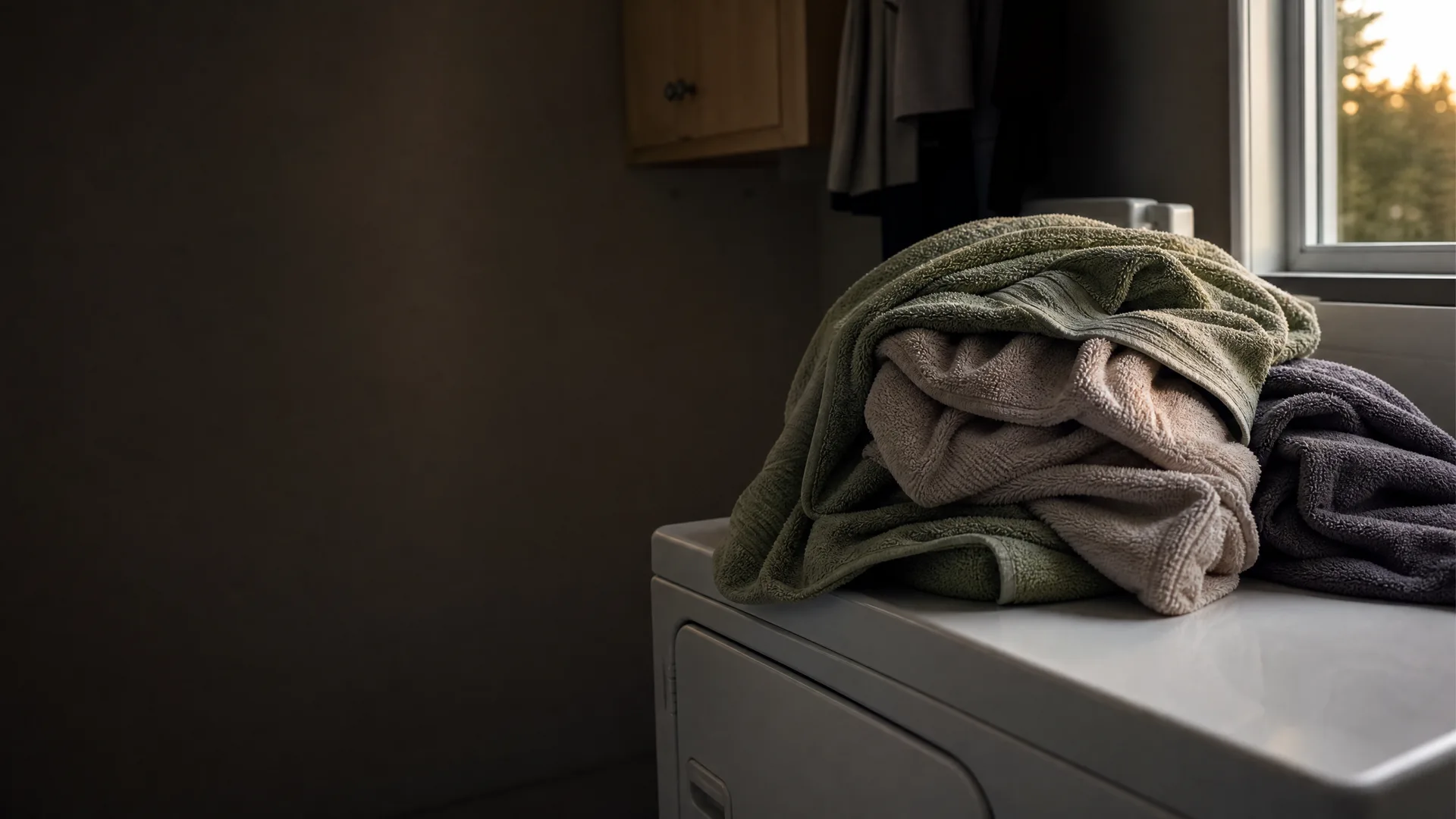
A pile of folded green, beige, and gray towels sits on top of a white washer or dryer in a dim room beside a window with trees outside.

It's almost nine on a Tuesday and you're still in the laundry room. This is the third time you've run these towels. You pull them out and they're warm at least, but still damp along the folds, and you stand there pressing a hand into one to check. The top of the dryer is hot enough that you notice it when you set your phone down. Out past the kitchen you can hear the furnace cycle on, that first cold snap of the Buffalo County fall settling into the house. You start the towels again, set the timer on your phone this time, and head back to bed, leaving the dryer running into the night.

Why does your dryer vent matter more in a house like yours?

  • 2.42 people per household on average

    With 2.42 people per household on average here, most homes are running a dryer several times a week, and a vent that's slow to clear catches up fast.

  • Half the homes here were built by 1980

    Half the homes in Buffalo County were built in 1980 or earlier, which means vent runs set up decades ago, often with turns or lengths that trap lint more easily.

  • Power here costs 10.72 cents per kilowatt-hour

    Power here runs 10.72 cents per kilowatt-hour, cheap enough that a dryer working harder through a clogged vent doesn't show up on the bill as fast as it should.

ACS 2020-2024 · EIA-861 2025

A white hooded dryer vent cover with a screened opening mounted on beige horizontal lap siding, with a blank white area filling the right side of the frame.

What the vent hood tells you

The vent hood sits on the outside wall where the dryer exhausts. Inside it is a flap, sometimes two, hinged to swing open when air pushes through. A clear vent pushes that flap open wide for the whole cycle. When lint has built up along the duct, the airflow weakens and the flap barely lifts, or it drops shut partway through a load even with the dryer still running.

A white hooded exterior vent cover with louvered grille mounted on light-colored horizontal lap siding, next to a blank wall corner.

Where the lint actually collects

The trap only catches what passes through its screen on the way out, and a lot of lint rides past it into the duct itself. That duct often runs through framing with turns and a long horizontal stretch before it reaches outside, and lint settles at every bend. Over time it narrows the path air can take. A duct that's clear end to end lets a load finish and lets the air carry all the way out instead of backing up partway.

2.42 people per household on average

At 2.42 people, most households here are doing laundry most days of the week, not once on a weekend. That means more loads pushing lint through the same vent run, so a partial clog gets found sooner, usually by a dryer that's taking noticeably longer to finish.

ACS 2020-2024

Catching it early

You notice the dryer is taking longer than it used to. Maybe a load that ran forty minutes now takes over an hour, and you start running towels twice without thinking much of it. The top of the machine feels a little warm to the touch. There's no smell yet, no lint showing up where it shouldn't. A cleaning now is a straightforward job, in and out, and the vent runs the way it did when the house was new. Nobody's pulled anything apart. The dryer just goes back to finishing a load in under an hour, and you stop thinking about it again.


Waiting it out

You keep running the dryer the way you always have, figuring the extra cycle is just how it is now. The lint trap looks fine, so the problem seems minor. But the clog downstream keeps packing in tighter with every load, and the motor and heating element are working harder to push air through a narrowing path. Eventually that shows up as a burning smell, or the vent hood flap barely moving when the dryer's running. By then it's not a quick clean anymore. It's a blocked line that's been heating up a dryer for weeks, and the clothes still come out damp.

A woman wrapped in a thick textured blanket sits on a sofa with an open book on her lap, beside a lit lamp and bookshelf, with a frost-patterned window behind her.
An older woman with grey-blonde hair in an updo and a beige turtleneck sweater smiles while looking to the side in a warmly lit kitchen, with a round loaf of bread on the counter in front of her and a dark window showing snow outside.

A dryer vent pro near you

Send it once and finding someone is no longer on you.

It costs nothing to send, and you don't have to hire anyone.

A white plastic hooded dryer vent with a mesh screen, fastened by four screws to beige horizontal lap siding above a concrete foundation wall.

Clear and working

The flap sits closed when the dryer is off and swings open wide once a load is running. Air moves out in steady, strong puffs. Check it from the yard while a load runs and you can feel that push against your hand.

A white plastic hooded dryer vent with a louvered grille mounted on horizontal vinyl siding above a textured concrete foundation wall.

Clogged and backing up

Lint has built up across the screen until the openings are mostly covered. The flap barely lifts, if it moves at all, and what air does escape carries visible lint with it. That's a vent not clearing the way it should.

What is this doing to your house right now

Walk past the laundry room and feel the door. If it's warmer than the rest of the hallway, heat that should be venting outside is building up in the room instead. Check your gas or power bill against last winter's. A dryer fighting a clogged vent pulls more energy to do the same job, load after load. There's a safety side too. Lint is fuel, and a vent packed with it sitting behind a hot dryer drum is how dryer fires start. None of this fixes itself. The clog sits in the duct and the flex line behind the machine, and it only gets worse the more loads you run through it.

  1. Lint builds up inside the vent hose with every load.

  2. Airflow slows, so hot moist air lingers in the drum.

  3. The dryer runs longer to finish each load.

  4. Heat and lint collect near the drum and exhaust duct.

A smiling man in an olive T-shirt and jeans stands in an open front doorway holding the door, facing a person in a navy polo and cap seen from behind in the foreground, with horizontal wood-look siding and a potted white flowering plant nearby.

What a clogged vent costs you at home

Every extra cycle you run to get a load dry pulls more power through the dryer, and in a house doing laundry most days that adds up on the bill before you'd think to check the vent for it. The heat that isn't leaving through the vent hood is leaving into your laundry room instead, so that room runs warmer than the rest of the house and the dryer itself works harder to push air through a duct that's fighting it the whole way.

There's also the part you can't see from the laundry room. Lint sitting against a hot duct wall is a fire risk, and it's one that builds quietly, load after load, until something trips it. You don't have to figure out whether your vent run is the problem or guess at how bad the buildup is. A contractor who works on vents in Buffalo County homes can look at yours directly, tell you what's actually going on in the duct, and take it from there.

A dark ceramic vase holding a leafy green branch sits on a round wooden table, with a blurred cushioned wooden armchair, woven basket, window and shelving with pottery in the background.
A white plastic louvered dryer vent hood mounted on beige horizontal lap siding above a concrete foundation wall bordered by gravel.

Vent cap, clear

The flap on this cap swings open and stays open while the dryer runs. Air pushes out steady against your hand if you hold it near the opening. No lint sits caught in the seam where the cap meets the siding, and the gravel bed below it stays dry after a full cycle.

A dusty white plastic dryer vent hood with lint-clogged louvers mounted on beige horizontal vinyl siding above a concrete foundation wall and a bed of rounded gray rocks.

Vent cap, clogged

Lint has packed into the louvers and the flap barely lifts, even mid-cycle. Some stays matted on the cap itself, dark against the siding above the foundation. Air that should push out in a steady stream only dribbles, and heat that can't escape works its way back into the house instead.

A dryer vent either moves air or it doesn't, and by now you know which one yours is doing. Longer cycles, a hot machine, damp towels after a full run, a vent hood flap that barely lifts: any one of these is worth a look, and more than one means the vent is overdue for a real cleaning. Nothing about this gets better by running another load. The lint already packed into that hose stays there until someone clears it out, and every cycle after this one is pushing more in behind it. Buffalo County winters put a gas furnace and a clogged dryer vent in the same house more often than not, and that's not a combination to let sit. Send the form and the job of finding someone to clear it stops being yours to carry. A contractor who works on vents like this will be in touch, and from there it's off your plate. The dryer, the vent, the extra time it's been taking: once this gets looked at, you'll stop thinking about it every time you start a load.

A metal hooded exterior vent cover with a screened opening, screwed to a dark rectangular plate on dark gray horizontal lap siding, with green foliage blurred at the lower left.

Get matched with a dryer vent pro in Buffalo County

Duct and vent cleaningBuffalo County, NE
Step 1 of 3

What kind of equipment?